

Section 1: Purpose
The primary purpose of the Code of Student Conduct is to establish standards and procedures necessary to maintain a community conducive to learning, whether on campus or online, and to advance the educational objectives of Oregon State University (OSU). The Code of Student Conduct promotes an environment that values inclusivity and respectful discourse. This Code applies to students at OSU (see Section 2) and is based on the belief that all persons should treat one another with dignity and respect for scholarship to thrive. Acknowledging that learning occurs in a multitude of places, OSU believes a set of community standards develops professionalism and decision-making in all students. OSU encourages exemplary conduct by balancing the rights of the individual student with responsibility to the larger community.
Choosing to join the OSU community as a student obligates each member to a code of responsible behavior. Policies support the health and safety of the OSU community, support a learning environment that is free from disruption, further the educational pursuits of community members, and limit property harm. Students are encouraged to hold each other accountable and report concerning behaviors, as the Code of Student Conduct strives to create a community that protects the safety, wellness, and educational focus of students. Students are also expected to follow the academic and professional standards of their academic units. All students and student organizations are expected to observe the policies, rules, and requirements of OSU as well as all applicable laws of municipalities and counties, the State of Oregon, the United States of America, and, when in another country, that country.
The student conduct process at OSU exists to protect the interests of the community and to challenge behavior that is not in accordance with our policies. This process is separate from criminal or civil court processes. Students who are accused of violating this Code will receive written notice and a hearing with objective decision-makers as part of our student conduct process. OSU is committed to making the student conduct process as accessible as possible for all students. Students with disabilities have the right to reasonable accommodation (see Section 5). No student will be found in violation of the Code of Student Conduct without a finding that it is more likely than not that a violation occurred (a preponderance of the evidence standard). Students found responsible in a student conduct process for violations of the Code are subject to sanctions. Sanctions are proportionate to the severity of the violation and to the cumulative conduct history of the student. Assigned sanctions provide an opportunity for students to reflect critically on their choices and behavior, to demonstrate learning, and, when appropriate, to make reparation for any harm that was caused. If a student is unable to tailor their behavior to community expectations or has exhibited sufficiently severe misconduct, the student conduct process may determine that the student should no longer share in the privilege of participating in this community.
Students are responsible for reading and abiding by the provisions of the Code of Student Conduct. Oregon State University reserves the right to make changes to this Code as necessary. Once those changes are posted online, they are in effect. The Code of Student Conduct is made available to students in the form of a link on Oregon State University’s website at www.scs.oregonstate.edu. To request a copy of the Code of Student Conduct, please contact [email protected].
Section 2: Definitions
- Accused or Respondent: Any student or student organization charged with a violation of the Code of Student Conduct.
- Code: Abbreviated term used to refer to the Code of Student Conduct.
- Complaint: Any individual or party who is the alleged recipient of behaviors that would violate the Code of Student Conduct.
- EOA: The Office of Equal Opportunity and Access. EOA serves as the University’s Title IX office and investigates concerns of sexual misconduct and/or discrimination.
- Hearing Body: The term used in the student conduct process to reference either a hearing officer (in an administrative conference) or a hearing committee (in a committee hearing).
- Institution or University: Refers to Oregon State University.
- Individual Violation: A violation of the Code of Student Conduct committed by an individual student acting alone or in concert with others independent of a student organization or its activities and events.
- Organizational Violation: A violation of the Code of Student Conduct committed by a student organization.
- Provisional Sanctions: Under the Code of Student Conduct, the Assistant Dean of Students, Director of SCS, or their designee may impose provisional sanctions that restrict or exclude a student or student organization’s presence on university property or at university events pending a conduct hearing when immediate action is necessary to ensure safety, protect property, or maintain normal university operations (see Section 9).
- Provisional Student Status: Assigned to any student who has been issued a suspension or expulsion sanction and has appealed the decision. A student may continue to progress academically; however, if the appeal is denied, the sanction becomes retroactive to the original date, and the student will not receive grades, credits, or degrees earned during the provisional period and may not receive refunds. Students excluded under institutional administrative suspension (see Section 9) are not eligible.
- Reporting Party: Any person or organization who submits a report or complaint indicating that a student may have violated the Code of Student Conduct. This may include witnesses or participants whose perspectives contribute to the report.
- SCS: The Office of Student Community Standards.
- Student: For the purpose of administering the Code of Student Conduct, a “student” is:
- Admitted: A person demonstrating acceptance of admission through participation in orientation programs or participation in University programs requiring student status.
- Enrolled: A person enrolled or dually enrolled in online or in‑person courses.
- Continuing: A person between academic terms; a graduate awaiting a degree; a person on approved educational leave; a person currently serving a suspension (including provisional suspension); a person not currently enrolled but eligible to register without reapplying; a person who withdraws while a disciplinary matter is pending; or a person eligible to receive the rights and privileges afforded to enrolled students.
- Student Organization: Includes recognized student organizations or student groups affiliated with an academic unit.
Section 3: Jurisdiction of the University and Responsibilities of Students
3.1 Jurisdiction
The Code of Student Conduct and the student conduct process apply to the conduct of all students and student organizations as defined by this Code. Additionally, the university retains conduct jurisdiction over students for any misconduct that occurred prior to any leave of absence, including withdrawal or graduation. If sanctioned or requested to participate in a student conduct process or investigation, a hold may be placed on the student’s ability to re-enroll, graduate, or obtain official transcripts until sanctions and/or participation expectations are completed. The university may invoke these procedures after the accused student has graduated in the event of serious misconduct in which health and safety is impacted or a serious and significant disruption to the educational environment is caused prior to a student’s graduation. Should the former student be found responsible, the university may withhold the student’s degree if they have not yet received it, or revoke that student’s degree and apply other sanctions as appropriate. The university may also invoke these procedures if an accused student leaves the university during a student conduct proceeding as defined in this code.
The Code of Student Conduct applies to behaviors that take place on university property or in online, extended or distance learning environments, including in social media, applications, or other electronic communications; at university-associated events; and off campus when the Assistant Dean of Students, Director of Student Community Standards, or their designee, determines that the off-campus conduct affects a substantial university interest. A substantial interest could include but is not limited to harm or threats of harm to health or safety, behavior that causes significant university community disruption, or behavior that is detrimental to the educational mission or interests of the university.
3.2 Freedom of Expression
Freedom of expression is essential to the university’s commitment to ensure inclusive educational opportunities. Freedom of expression, which includes freedom of speech, is a fundamental right guaranteed by the U.S. and Oregon constitutions.
Freedom of expression does not generally extend to specific threats of violence against individuals, and generally cannot be exercised in ways that significantly disrupt the operation of the university or the legal rights of others. The university may reasonably regulate the time, place, and manner of expression to ensure that it does not disrupt the university’s activities. In particular, the university will not take disciplinary action under this Code for speech activities that disclose or discuss, in good faith, factual information relating to a claim of prohibited discrimination, harassment or retaliation. However, the university may respond in other ways to facilitate dialogue or education.
3.3 Additional Points of Potential Responsibility
Some students may have multiple points of accountability. For example, students may have a scholarship or participate in a university program that holds students accountable under its own guidelines. Students may also be involved in a concurrent legal process (see Section 3.7). Students with other affiliations—including but not limited to student organization membership, university-affiliated programs (e.g., ROTC), academic programs (e.g., study abroad), NCAA athlete status, or visa status—may be subject to processes or standards in addition to this Code.
3.4 Student Responsibility for Communications
Students are responsible for all communication delivered to their Oregon State University email address. Oregon State University email is OSU’s method of communication with students. The university is not responsible for email messages that are not received by the student. The university considers communication and notification to be completed when it is sent to a student’s Oregon State University email account. If students do not review or act on emails received, our processes will move forward. Such processes could result in the placement of registration holds, conducting hearings without student participation, and the issuance of decisions and sanctions regarding alleged student behavior.
3.5 Reporting
Anyone may seek resolution of violations of the Code of Student Conduct committed against them by members of the Oregon State University community. Student information is protected by the Family Educational Rights and Privacy Act (FERPA) as well as Oregon state law and University Policy & Standards; therefore, the university may not be able to communicate outcomes to reporting parties who are not victims of a crime of violence or non-forcible sex offense or who do not have an educational need to know, except to confirm receipt of the report. The university may report relevant outcomes to victims of misconduct when such outcomes have a direct impact on the victim.
The university may reach out via phone to reporting parties and/or victims to gather additional information. All official SCS communications will be in writing, typically via email.
To increase safety, security, and accountability and to preserve the educational environment, the university encourages community members to report known instances of alleged misconduct, as outlined in Section 4, to SCS. There is no set or defined time limit on reporting violations of the Code of Student Conduct; however, the longer someone waits to report an offense, the harder it becomes for university officials to obtain information and witness accounts and to make determinations regarding alleged violations. The university will accept complaints from parties who do not wish to be identified; however, in order to provide full due process to a responding student, the university may be limited in its ability to investigate and respond to such a complaint. SCS is also willing to consult with individuals or groups that have witnessed or otherwise been impacted by disruptive or concerning behavior to provide applicable resources and help identify which pathways for resolution are most appropriate.
3.6 Reporting Amnesty
Oregon State University encourages all community members to report behavior associated with sexual harassment and sexual assault (Section 4.4 or Section 4.5). To support such reporting, except for the specific reasons noted below, the university will not pursue student conduct proceedings against a reporting student, a complainant, or a witness for personal use of alcohol, marijuana, or other drugs, trespassing or unauthorized entry of university-owned or operated facilities, or other violations of the Code, occurring at or near the time of the alleged incident of sexual misconduct.
Additionally, the university will not pursue student conduct proceedings against a respondent for personal use of alcohol, marijuana or other drugs, at or near the time of the incident. Oregon State University may, however, initiate and educational discussion with any student regarding any behavior that, without reporting amnesty, could violate the Code.
Exceptions: At the discretion of the Assistant Dean of Students, Director of Student Community Standards, or their designee, a reporting party, a complainant, a witness, or a respondent will not be granted reporting amnesty if their behavior placed the health or safety of any other person at risk, if the university determines that the report of sexual misconduct was not made in good faith, or the violation of the Code was egregious.
3.7 Violations of the Law
Alleged violations of federal, state and local laws may be investigated and addressed under the Code of Student Conduct. When an alleged offense occurs over which the university has jurisdiction, the student conduct process may go forward regardless of any criminal complaint that may or may not arise from the same incident or the status of any criminal or civil proceeding. The university reserves the right to exercise its authority of administrative suspension upon notification that a student and/or student organization is subject to a criminal investigation and/or complaint (for additional grounds for administrative suspension, see Section 9).
The university may choose to proceed toward resolution of an alleged violation when sufficient information has been obtained and/or is available. The university will apply a preponderance standard of evidence (see Section 5.2 – Standard of Proof) to determine responsibility for the alleged violation(s) of this Code and will make decisions independent of criminal resolution through the courts.
Because SCS is applying this Code to student behavior, student conduct processes may proceed regardless of whether accused students or student organizations criminal charges, civil actions, or other university proceedings regarding the same incident are pending or have been terminated, dismissed, reduced, or not yet adjudicated.
Students accused of crimes sometimes voluntarily choose to withdraw from the university until the criminal charges are resolved. The institution, however, may still choose to immediately move forward, may delay the process until more information becomes available, or may work with a student to identify a new timeline that is agreeable to all parties. In situations where a student chooses to withdraw while there is a pending student conduct complaint, the student is subject to the following conditions:
-
The accused student should remain in communication with the university regarding all campus investigative efforts; and
-
The accused student must comply with all interim actions, restrictions, and/or determinations (including sanctions) as a result of the student conduct process during the leave of absence.
Section 4: Prohibited Conduct
4.1 Behavioral Expectations
Oregon State University considers the behavior described in the following sub sections to be inappropriate for the Oregon State University community. These expectations apply to all students and student organizations, regardless of the location of the behavior except as specified below. Findings of violations will be based on behavior, rather than other factors (such as intent, knowledge, state of mind, etc.) relating to the behaviors, unless otherwise stated. If a violation of the Code of Student Conduct is found, mitigating or aggravating factors will then be considered and will potentially influence the severity of any sanctions. Any student found to have committed or to have attempted to commit the following misconduct is subject to the sanctions outlined in Section 6.
The following conduct is prohibited under the Code of Student Conduct:
4.2 Academic Misconduct
Any action that misrepresents a student or group’s work, knowledge, or achievement, provides a potential or actual inequitable advantage, or compromises the integrity of the educational process. Prohibited behaviors include, but are not limited to doing or attempting the following actions:
- Cheating. Unauthorized assistance, or access to or use of unauthorized materials, information, tools, or study aids. The use of cell phones, internet, generative artificial intelligence, or other electronic devices is prohibited unless expressly authorized by the instructor. Examples include, but are not limited to, unauthorized collaboration or copying on a test or assignment, using prohibited items, materials and texts.
- Plagiarism. Representing the words or ideas of a source or presenting a source's words, data, expressed ideas, or artistry as one's own. Examples include, but are not limited to, presenting someone else's opinions and theories as one's own, using another person's work or words (including unpublished material) without appropriate source documentation or citation, working jointly on a project and then submitting it as one's own, using material generated by artificial intelligence without appropriate source documentation or citation, etc.
- Falsification. Fabrication or invention of any information. Examples include, but are not limited to, falsifying research, inventing or falsely altering data, citing fictitious references, falsely recording or reporting attendance, hours, or engagement in activities such as internships, externships, field experiences, clinical activities, etc.
- Assisting. Any action that helps another engage in academic misconduct. Examples include, but are not limited to, providing materials or assistance without approval, altering someone's work, grades or academic records, taking a test/doing an assignment for someone else, compelling acquisition, selling, bribing, paying or accepting payment for academic work or assistance that contributes to academic misconduct, etc.
- Tampering. Interfering with an instructor’s evaluation of work by altering materials or documents, tampering with evaluation tools, or other means of interfering.
- Multiple submissions of work. Using or submitting work completed for another or previous class or requirement, without appropriate disclosure, citation, and instructor approval.
-
Unauthorized recording and use. Recording and/or dissemination of instructional content without the express permission of the instructor(s), or an approved accommodation coordinated via Disability Access Services.
4.3 Behavioral Misconduct
- Alcohol. The following behavior is prohibited:
- use, possession, or procurement of alcohol by persons under the legal drinking age; students are also considered to be in possession if the substance is in their bodies or the use is otherwise detectable;
- furnishing, manufacturing, distributing, or selling alcohol except as expressly permitted by law and the university’s policies regarding alcohol;
- driving while under the influence of alcohol in a manner that results in a demonstratable impairment of mental or physical faculties;
- public intoxication, possession, or use while on university property or at events except as expressly permitted by university policies regarding alcohol;
- disruptive behavior or other Code violations due to alcohol intoxication regardless of location;
- failure of a student organization to take all necessary steps to ensure that no person under the legal drinking age possesses alcoholic beverages at functions it sponsors or organizes, or within any property or transportation it owns, operates, and/or rents;
- using alcohol to facilitate incapacitation or forcing ingestion of alcohol without consent; or
- use, or possession, of alcohol in a way that is prohibited by applicable law.
- Marijuana. The following behavior is prohibited:
- use, possession, or procurement of marijuana or its derivatives or paraphernalia related to use by persons under the legal age; students are also considered to be in possession if the substance is in their bodies or the use is otherwise detectable;
- public intoxication, possession, or use of marijuana or its derivatives or paraphernalia related to use while on university property or at university events;
- furnishing, manufacturing, distributing, or selling marijuana or its derivatives except as expressly permitted by law;
- driving under the influence of marijuana or its derivatives;
- disruptive behavior or other Code violations due to marijuana or cannabis intoxication regardless of location;
- failure of a student organization to take all necessary steps to ensure that no person under the legal age possesses or consumes marijuana or its derivatives at functions it sponsors or organizes, or within any property or transportation it owns, operates, and/or rents;
- facilitating incapacitation or ingestion without consent through the use of marijuana or its derivatives; or
- use, or possession, of marijuana in a way that is prohibited by applicable law.
- Drugs. The following behavior is prohibited, where “drugs” includes but is not limited to federally controlled substances, synthetic drugs or inhalants, natural substances used for drug effects, and medication used/possessed/handled in non-prescribed manners:
- use, possession, or procurement of drugs or paraphernalia related to use; students are also considered to be in possession if the substance is in their bodies or the use is otherwise detectable.
- furnishing, manufacture, distribution, or sale of drugs except as expressly permitted by law;
- public intoxication due to drug use;
- driving under the influence of drugs;
- disruptive behavior or other Code violations due to drug intoxication regardless of location
- failure of a student organization to take all necessary steps to ensure that no person possesses or consumes drugs at functions it sponsors or organizes, or within any property or transportation it owns, operates, and/or rents; or
- facilitating incapacitation or ingestion without consent through the use of drugs.
- Disruptive or Disorderly Conduct. Conduct that may contribute to:
- unreasonable noise;
- disturbance of the public peace;
- offensive public behavior (such as public urination or defecation or indecent or public exposure of intimate body parts as prohibited by law, even when it does not rise to the level of sexual or discriminatory misconduct, found in Section 4.4).
- violent, threatening, and/or severely disruptive behavior; or
- disruption of Oregon State University operations including obstruction of teaching, research, administration, other Oregon State University activities, and/or other authorized non-university activities which occur on or in university physical or virtual spaces.
- Harm to Persons. Conduct that causes physical, emotional, or psychological injury or distress to another individual.
- Endangerment. Conduct that creates a substantial risk of harm to the safety, health, or well‑being of oneself or others, even if no actual harm occurs.
- Threats. Written, oral, or physical conduct that causes a reasonable expectation of injury to the health or safety of any person or damage to property.
- Bullying. Repeated behavior intended to intimidate, harm, control, or diminish the physical, emotional, or psychological well‑being of the targeted individual.
- Endangerment. Conduct that creates a substantial risk of harm to the safety, health, or well-being of oneself or others, even if no actual harm occurs.
- Threats. Written, oral, or physical conduct that causes a reasonable expectation of injury to the health or safety of any person or damage to any property.
- Bullying. Repeated behavior intended to intimidate, harm, control, or diminish the physical, emotional, or psychological well-being of the targeted individual.
- Harassment. Repeated, persistent, severe, or pervasive actions directed toward specific individual(s) with the intent or effect to harass, harm, or alarm, including attempted or threatened physical contact, or acts that create the reasonable apprehension of unwanted contact. Such acts may include but are not limited to face-to-face interactions, phone calls, text messages, and/or use of social media.
- Hazing. Conduct that endangers the mental or physical health or safety of any person, or that destroys, damages, or removes public or private property, and is related to the initiation, admission into, affiliation with, advancement within, or general member participation in a group, organization, social or academic program, regardless as to whether or not the actions are sanctioned or approved by the organization or continued membership or standing is contingent upon participation. Participation or cooperation by the person(s) being hazed does not excuse the violation.
- Retaliation. Any adverse action taken by an individual against or toward a person who is, or is perceived to be, engaged in an investigation, a report, or a student conduct process with SCS because that person participated in a student conduct process, or to deter a person from participating in a student conduct process.
- Abuse of Conduct Process. Abuse, disruption, or interference with, or failure to comply with outcomes of, the university student conduct process as outlined in this Code, including, but not limited to:
- falsification, destruction, or misrepresentation of information provided in a conduct process or investigation;
- attempting to discourage or influence an individual’s good faith participation in, or use of, the student conduct process;
- intentionally initiating or causing to be initiated any false report; or
- failure to complete or comply with or attempt to bypass any sanctions(s) imposed, directives, interim actions, or the terms of resolution identified by the conduct processes.
- Failure to Comply. Failure to comply with any reasonable directive of Oregon State University faculty, staff, or Department of Public Safety officers, or law enforcement officers during the performance of their duties. This includes, but is not limited to, failures to: adhere to no-contact directives, identify one-self upon request, remove oneself from premises or disperse as group, cease and desist, etc.
- Falsification. Knowingly providing/ presenting, creating, or possessing false, falsified or forged materials, documents, accounts, records, identification, payments, or financial instruments.
- Theft. Unauthorized taking of property of another, including goods, services and other valuables, or knowingly taking or maintaining possession of stolen property.
- Damage or Destruction. Damage to or destruction of Oregon State University property or the property of another.
- Unauthorized Access or Use. Misuse of access privileges to any premises or unauthorized entry to or use of property or physical or virtual space, including trespassing, hacking, propping doors or windows, or providing unauthorized access. Also, misuse of Oregon State University-related access privileges, including unauthorized possession, duplication, sharing or use of means of access to any university building or property (i.e.keys, cards, etc.); failure to immediately report a lost Oregon State University card, key, or other means of access which results in unauthorized entry or access; failure or refusal to vacate; or unauthorized use of alarmed doors for entry or exit.
- Weapons. Possession, use, or threatened use of dangerous chemicals, any switchblade or similar knife, hunting or target bow, crossbow, dirk, dagger, slingshot, metal knuckles, or similar instrument; or a projectile containing an explosive or incendiary material or other chemical substance, or a bomb, grenade, missile, or similar instrument are prohibited on university-owned or controlled property and at university-sponsored activities, unless expressly authorized by law and applicable policies. Weapons, as listed above, possessed, used or handled off-campus in a manner that is unlawful or contributes to any other violation of the Code of Student Conduct is also prohibited. Possession of a firearm on university-owned or controlled property is also prohibited for students. Additionally, any violation of the institutional standards and policies on firearms and weapons found in the UHDS policy guide (see Section 4.3 Footnotes, #1), and in the University Policies and Standards (see Section 4.3 Footnotes, #2 and #3), also constitute a violation of this Code.
- Smoking and Tobacco Use. Smoking, carrying any lighted inhalant delivery instrument, or using any tobacco product is prohibited:
- within enclosed university-owned or controlled facilities, including but not limited to offices, reception areas, laboratories, lavatories, classrooms, stairwells, hallways, lobbies, meeting rooms, gymnasiums, elevators, and storage rooms;
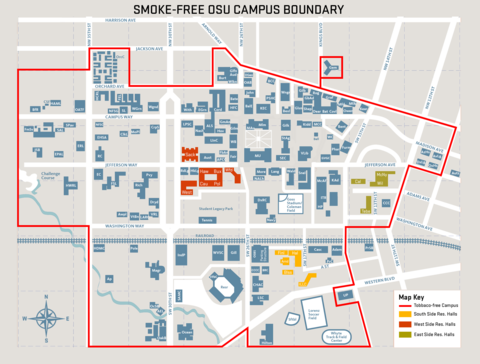
- in any indoor or outdoor spaces, including but not limited to parking lots, grounds, rooftops, athletic facilities, entrances and exit ways, and experiment stations;
- within all vehicles on university-owned or controlled property; and,
- within any university-owned or controlled vehicle.
Persons under 21 years of age are not permitted to possess tobacco products or inhalant delivery systems while present on university owned or controlled property, or while attending university sponsored events. This section does not apply to a person for whom a tobacco or nicotine product or a substance to be used with an inhalant delivery system has been lawfully prescribed. This section does not apply to the use of tobacco products as part of scientific research studies and ceremonial activities as those terms are defined in OSU Standards. Visit the the Oregon State University Smoking and Tobacco Use on Campus Policy for more information (see Section 4.3 Footnotes, #4); a map of the Corvallis campus boundaries is below and downloadable from the College of Health.
- Misuse of Computing Resources. Violating Oregon State University Acceptable Use of Computing Resources Policy, found online (see Section 4.3 Footnotes, #5). This includes, but is not limited to, the unauthorized transfer of copyrighted material, use of computing resources to engage in unlawful behavior, and threats, abuse, or harassment made or transmitted via electronic forums or electronic mail.
- Unauthorized Recording. Making, sharing, or otherwise distributing any audio, video, photographic, or digital recording or image, which was taken without a person’s prior knowledge or consent when the person being recorded would have a reasonable expectation of privacy, or where the recording is reasonably likely to cause injury or distress.
- Failure to Disclose. Failure of a student to disclose or any misrepresentation by a student of information required as a matter of application to the university or university program, such as criminal convictions, requirements to disclose sex offender status, etc. Failure of a student to update any previously required disclosures, immediately upon status change, such as expungement, conviction, legal requirements to disclose, etc.
- Other University Polices. Violating other applicable Oregon State University polices, standards, rules, or agreements.
- Unlawful Behavior. Engaging in conduct that is prohibited by local, state, or federal laws.
- Collusion. Acting with others with the intent to violate or support others in committing a violation of the Code of Student Conduct
4.4 Discrimination and Discriminatory Harassment
- Discrimination. Conduct, either intentional or unintentional, based on a protected status that:
- Excludes an individual from participation in any university program or activity for which they are otherwise eligible; or
- Denies the individual the benefits of a university program or activity for which they are otherwise eligible; or
- Otherwise adversely affects a term or condition of an individual’s employment, education, on-campus housing, or participation in a university program or activity (see Section 4.4 Footnotes, #1).
- Discriminatory Harassment. Unwelcome conduct on the basis of a protected status that, based on the totality of the circumstances and regardless of intent, is subjectively and objectively offensive and sufficiently severe or pervasive that:
- It creates an intimidating, hostile, or offensive environment in which to work, learn, or participate in a university program or activity; or,
- It unreasonably interferes with, limits, or denies the individual’s academic pursuits, employment, or ability to participate in or benefit from a university program or activity.
4.5 OSU Sex Discrimination and Sexual Misconduct (see Section 4.5 Footnotes, #1)
- Sex Discrimination. Conduct, either intentional or unintentional, On the Basis of Sex (see Section 4.5 Footnotes, #2), that:
-
Excludes an individual from participation in any university program or activity for which they are otherwise eligible; or
-
Denies the individual the benefits of a university program or activity for which they are otherwise eligible; or
-
Otherwise adversely affects a term or condition of an individual’s employment, education, on-campus housing, or participation in a university program or activity (see Section 4.5 Footnotes, #3).
-
- Sex-Based Discriminatory Harassment (see Section 4.5 Footnotes, #4). Unwelcome conduct On the Basis of Sex that, based on the totality of the circumstances and regardless of intent, is subjectively and objectively offensive and sufficiently severe or pervasive that:
- It creates an intimidating, hostile, or offensive environment in which to work, learn, or participate in a university program or activity; or
- It unreasonably interferes with, limits, or denies the individual’s academic pursuits, employment, or ability to participate in or benefit from a university program or activity; and
- Sexual Harassment. Unwelcome conduct of a sexual nature, including unwelcome sexual advances, requests for sexual favors, or other verbal, nonverbal, or physical conduct of a sexual nature when:
- Submission to such conduct is made either explicitly or implicitly a term or condition of an individual’s employment, education, or other education program or activity, including an aid, benefit, or service; or
- Submission to or rejection of such conduct by an individual is used as the basis for employment, education, or other education program or activity, including an aid, benefit, or service, decision affecting an individual; or
- Such conduct, based on the totality of the circumstances and regardless of intent, is subjectively and objectively offensive, and sufficiently severe or pervasive that: it creates an intimidating, hostile, or offensive environment in which to work, learn, or participate in a university program or activity; or it unreasonably interferes with, limits, or denies the individual’s academic pursuits, employment, or ability to participate in or benefit from a university program or activity.
-
Non-Consensual Sexual Contact. Unwelcome intentional sexual touching of a person’s private body part (including, but not limited to, breasts, buttocks, groin, or genitals) or of a person’s body by someone else’s private body part; causing a person touch their own or another person’s private body parts without consent; or any other unwelcome intentional bodily contact made in a sexual manner or for a sexual purpose. Non-consensual sexual contact can include kissing or fondling without consent.
-
Non-Consensual Sexual Intercourse. Any sexual intercourse by a person upon another person that is without consent. Intercourse includes vaginal, anal, or oral penetration by a penis, finger, tongue, or any object, and mouth-to-genital contact, no matter how slight the penetration or contact.
- Intimate Partner Violence. Intimate Partner Violence (“IPV”), includes dating violence, domestic violence, and other types of relationship violence. IPV is defined as intentionally or recklessly causing physical, emotional, or psychological harm to a person who is, or has been involved in, a sexual, dating, or other intimate relationship with the Respondent (see Section 4.5 Footnotes, # 5). IPV includes, but is not limited to, threatened acts of violence, including threatened self-harm for the purpose of controlling an individual and threats to harm the individual’s family members, pets, or friends.
- IPV can encompass a broad range of behavior for the purpose or effect of controlling another individual, including all prohibited behavior in this policy. It may involve one act or an ongoing pattern of behavior.
- If there is a question whether a relationship exists, EOA will make the determination based on the parties’ description of their interactions, the frequency of interaction between the parties, and consideration of the length and type of interactions.
- Stalking. Engaging in a course of conduct On the Basis of Sex, that is directed at a specific person that would cause a Reasonable Person to fear for their own or others’ safety, or to suffer substantial emotional distress.
-
“Course of conduct” means two or more acts, including, but not limited to, unwanted contact, property invasion or damage, watching, following, surveilling (using tracking devices, monitoring online activity, etc.) sabotage, threats, violence, and attacks. Stalking can occur in person, via third parties, and/or using technology.
-
“Substantial emotional distress” means significant mental suffering or anguish that may, but does not necessarily, require medical or professional treatment or counseling.
-
Merely annoying conduct, even if repeated, is a nuisance, but generally is not considered stalking.
-
- Sexual Exploitation. Taking non-consensual or abusive sexual advantage of another for one’s own benefit or for the benefit of anyone other than the person being exploited. Examples of sexual exploitation include, but are not limited to:
-
Purposefully observing or allowing others to observe a person undressing, using the bathroom, or engaging in sexual activity, when conducted in a private space and without the consent of all parties involved.
-
Exposing one’s genitals or inducing another to expose their genitals in nonconsensual circumstances.
-
Non-consensual photographing, recording, sharing or streaming of images, photography, video or audio recording of sexual activity or nudity conducted in a private space, or distribution of such without the knowledge and consent of all parties involved;
-
Creating or disseminating media, including images, videos, or audio representations of individuals doing or saying sexually-related things that never happened, or placing identifiable real people in fictitious pornographic or nude situations without their consent;
-
Misappropriation of another person’s identity on apps, websites, or other venues designed for dating or sexual connections;
-
Extortion or otherwise forcing a person to take an action against that person’s will by threatening to show, post, or share information, video, audio, or an image that depicts the person’s nudity or sexual activity;
-
Viewing, or possessing, or enabling or facilitating the viewing, creation, or trafficking of child sexual abuse images or recordings;
-
Knowingly soliciting a minor for sexual activity.
-
Engaging in sexual activity with another person while knowingly infected with human immunodeficiency virus (HIV) or a sexually transmitted disease (STD) or infection (STI), without informing the other person of the virus, disease, or infection;
-
incapacitation of another person (through alcohol, drugs, or any other means) for the purpose of making another person vulnerable to non-consensual sexual activity; or
-
Engaging in sex trafficking, and/or coercing another person to engage in sexual acts in exchange for money, goods, housing, or favors.
-
4.6 Title IX Sexual Misconduct
- Title IX Sexual Harassment. Any conduct On the Basis of Sex that satisfies one or more of the following:
- A university employee conditioning the provision of an aid, benefit, or service on an individual’s participation in unwelcome sexual conduct;
- Unwelcome conduct determined by a Reasonable Person to be so severe, pervasive, and objectively offensive that it effectively denies a person equal access to a university educational program or activity;
- Title IX Sexual Assault. An offense classified as a forcible or nonforcible sex offense under the uniform crime reporting system of the Federal Bureau of Investigation;
- Sex Offenses, Forcible. Any sexual act directed against another person, without the consent of the complainant including instances where the complainant is incapable of giving consent.
- Forcible Rape. Penetration, no matter how slight, of the vagina or anus with any body part or object, or oral penetration by a sex organ of another person, without the consent of the complainant.
- Forcible Sodomy. Oral or anal sexual intercourse with another person, forcibly and/or against that person’s will (non-consensually) or not forcibly or against the person’s will in instances where the complainant is incapable of giving consent because of age or because of their temporary or permanent mental or physical incapacity.
- Sexual Assault with an Object. To use an object or instrument to penetrate, however slightly, the genital or anal opening of the body of another person, forcibly and/or against that person’s will (non-consensually) or not forcibly or against the person’s will in instances where the complainant is incapable of giving consent because of age or because of their temporary or permanent mental or physical incapacity.
- Title IX Sexual Contact. The intentional touching of the clothed or unclothed body parts without Consent of the Complainant for the purpose of sexual degradation, sexual gratification, or sexual humiliation. The forced touching by the Complainant of the Respondent’s clothed or unclothed body parts, without Consent of the Complainant for the purpose of sexual degradation, sexual gratification, or sexual humiliation. This offense includes instances where the Complainant is incapable of giving Consent because of age or incapacity due to temporary or permanent mental or physical impairment or intoxication.
- Sex Offenses, Nonforcible. Nonforcible sexual intercourse.
-
Incest. Nonforcible sexual intercourse between persons who are related to each other within the degrees wherein marriage is prohibited by law.
-
Statutory Rape. Nonforcible sexual intercourse with a person who is under the statutory age of consent.
-
- Sex Offenses, Forcible. Any sexual act directed against another person, without the consent of the complainant including instances where the complainant is incapable of giving consent.
- Title IX Dating Violence. Violence committed by a person who is or has been in a social relationship of a romantic or intimate nature with the complainant.
- The existence of such a relationship shall be determined based on the complainant’s statement and with consideration of the length of the relationship, the type of relationship, and the frequency of interaction between the persons involved in the relationship. For the purposes of this definition:
- Dating violence includes, but is not limited to, sexual or physical abuse or the threat of such abuse
- Dating violence does not include acts covered under the definition of title IX domestic violence.
- The existence of such a relationship shall be determined based on the complainant’s statement and with consideration of the length of the relationship, the type of relationship, and the frequency of interaction between the persons involved in the relationship. For the purposes of this definition:
- Title IX Domestic Violence. An act of violence committed by:
-
A current or former spouse or intimate partner of the complainant,
-
A person with whom the complainant shares a child in common,
-
A person who is cohabitating with or has cohabitated with the complainant as a spouse or intimate partner,
-
A person similarly situated to a spouse of the complainant under applicable law,
-
Any other person against a complainant who is protected from that person’s acts under applicable domestic or family violence laws.
-
- Title IX Stalking. Engaging in a course of conduct directed at a specific person that would cause a Reasonable Person to:
-
Fear for their safety or the safety of others; or
-
Suffer substantial emotional distress.
- For the purposes of this definition:
- Course of conduct means two or more acts, including, but not limited to, acts in which the individual directly, indirectly, or through third parties, by any action, method, device, or means, follows, monitors, observes, surveils, threatens, or communicates to or about a person, or interferes with a person’s property.
- Reasonable Person means a reasonable person under similar circumstances and with similar identities to the complainant.
- Substantial emotional distress means significant mental suffering or anguish that may but does not necessarily require medical or other professional treatment or counseling.
-
-
Title IX Retaliation. Intimidating, threatening, coercing, or discriminating against any individual for the purpose of interfering with any right or privilege secured by Title IX, or because the individual has made a report or complaint, testified, assisted, or participated or refused to participate in any manner in an investigation, proceeding, or hearing under the university’s Title IX Investigation and Resolution process.
Section 5: Student Conduct Process and Procedures
The goal of the student conduct process is to determine whether a student is responsible or not responsible for violating the Code of Student Conduct; therefore, when issuing a notice of allegations, the university does not make an assumption either way but rather reviews all of the evidence available to make a determination of responsibility.
The Assistant Dean of Students, Director of Student Community Standards, or their designee, is responsible for the coordination and implementation of the student conduct process. The Assistant Dean of Students, Director of SCS will designate administrative faculty members in the office of Student Community Standards, within the office of University Housing and Dining Services, or trained university community members to serve as administrative hearing officers in the student conduct process.
The Assistant Dean of Students, Director of SCS will refer reports of Discrimination and Discriminatory Harassment (see Section 4.4), OSU Sex Discrimination and Sexual Misconduct (see Section 4.5) or Title IX Sexual Misconduct (see Section 4.6) to the office of Equal Opportunity and Access (EOA) for investigation. Sexual/Gender-Based Misconduct investigations will be initiated and facilitated in accordance with the procedures identified in Oregon State University’s Sexual Misconduct and Discrimination Investigation and Resolution Process for Complaints against Students and Oregon State University’s Investigation and Resolution Process for Title IX Complaints. For more information about procedures utilized by EOA, please contact [email protected].
5.1 Notice of Allegations
If SCS receives a complaint, report, or conducts an investigation and determines that sufficient information exists to indicate that a student/student organization may have violated the Code of Student Conduct, the Assistant Dean of Students, Director of SCS, or their designee, will notify the student/student organization in writing in a notice of allegations of the alleged violation(s). The notice of allegations will identify the alleged behaviors, the approximate date, time, and location of the alleged behavior, the Code of Student Conduct sections that are alleged to have been violated and which hearing body will review the matter.
The notice of allegations will provide the student/student organization with directions and details regarding scheduling a date, time, and location for an administrative conference or SCS committee hearing.
Generally, if a student/student organization does not respond to the notice of allegations and/or schedule an administrative conference or SCS committee hearing, SCS will schedule a hearing date and time for the student/student organization. SCS will notify the student/student organization in writing of the scheduled date, time, and location. The period of time between the hearing date and the provision of the notice will be at least five (5) business days unless otherwise agreed upon by the assigned hearing body and the accused student/student organization. SCS may also place a hold on the student’s registration until the student either schedules and/or participates in a hearing. SCS may also schedule the hearing if the student/student organization does not respond or chooses not to participate.
In instances where a student/student organization misses a scheduled meeting without notifying the appropriate hearing body in advance, the hearing may be conducted in the absence of the student/student organization. If the case is heard in their absence, the notice of decision will be sent to the student/student organization via email. The hearing officer or body may also choose to place a hold on the student’s registration until the student either reschedules and/or participates in a hearing. In these cases, notice and proceedings will occur in alignment with the processes and procedures described in the Oregon State University Sexual Misconduct Policy, as referred to in Section 5.12 of this Code.
5.2 Standard of Proof
The university will use a preponderance of the evidence standard when making determinations about whether a student/student organization is or is not responsible for violations of the Code of Student Conduct. A preponderance standard of evidence means that a violation of the Code of Student Conduct is based on a determination that the prohibited behavior was more likely than not to have occurred.
5.3 Investigations
There are some instances in which the university needs more information to determine how to best proceed with an allegation of student misconduct.
In such a case, the university may initiate investigatory meeting(s). Investigatory meetings may be conducted with the accused students/student organizations, complainants, witnesses, reporting parties or any other individuals who may have knowledge of the case. SCS may also choose to place a hold on the student’s registration until the student responds to the request to meet.
During an investigatory meeting, the university is looking into the nature of the incident, complaint or notice, the evidence available, and information related to the parties involved. This process may lead to:
- a determination that the case or investigation should be closed at that time, because either there is insufficient evidence to pursue the investigation or because the behavior alleged, even if true, would not violate the Code of Student Conduct;
- a more comprehensive investigation, when there is sufficient evidence that an incident in violation of the Code of Student Conduct may have occurred and more information must be gathered; or
- a notice of allegations letter and initiation of the appropriate student conduct proceedings.
5.4 Participation by Students/Student Organizations
Students/student organizations are strongly encouraged to directly participate in all stages of the student conduct process. Because the student conduct process is educational in nature, and because information related to mitigating and aggravating circumstances is considered, students/student organizations are best positioned to provide such information and enhance their own learning through direct participation. If students/student organizations choose to not participate in the process, the case may proceed without them and a decision may be made in the absence of any input from the student/student organization.
5.5 Advisors
At any stage of the process, an accused student, accused student organization, or complainant may be accompanied by any one (1) advisor of the student's or student organization’s choice, so long as the advisor is not a party to the alleged incident (such as a witness, complainant, or additionally accused student) and that their presence, participation, or availability does not hamper the timeliness or procedure of a meeting, investigation, or hearing. Except as may be provided for in the Title IX Process, the advisor is not permitted to speak on behalf of the student or student organization in a conduct hearing or meeting; the student or student organization will be expected to speak for themselves at all times.
By bringing an advisor, the student explicitly consents to university officials speaking openly regarding student information in the presence of any advisor while they accompany a student. If students or student organizations wish to waive their privacy rights to give further permission to the university to otherwise share private information, they may do so in writing via the Student Conduct and Community Standards office.
5.6 Accessibility
SCS is committed to making the student conduct process as accessible as possible for all students. Students unable to participate in person may request arrangements to participate in other ways (including by providing written statements, through telephonic or online means, etc.). Students with disabilities have the right to reasonable accommodation.
Non-native English speakers may request translation services (the cost for these services maybe charged to the student). Students who require a disability accommodation, language support, who are off campus or otherwise indisposed, or who may have other factors that could impact their ability to participate in the student conduct process should contact SCS at least three (3) business days prior to a meeting, conference or hearing at [email protected] to make a request, which will then be reviewed by SCS. SCS’s ability to meet requests may be limited without enough advance notice.
5.7 Pre-Process Preparation
Students/student organizations accused in a student conduct process may choose to prepare in advance for their administrative conference or committee hearing. In addition to making any requests for reasonable accommodations necessary (see Section 5.6 Accessibility), a student is permitted to meet with a staff member to ask questions about the conduct process, and/or identify (in relevant cases) if they can bring or suggest witnesses and the process to do so. A student is also permitted to review collected evidence during a mutually agreed upon time before the hearing. This review period is provided at least 24 hours, but not more than 72 hours, before the hearing. The student/student organization is welcome to bring an advisor with them at any step in the student conduct process, as long as they follow the expectations identified in Section 5.5.
Students/student organizations accused in a student conduct process may choose to prepare in advance for their administrative conference or committee hearing.
5.8 Academic Integrity Process
Academic misconduct violations (see Section 4.2) are primarily investigated and adjudicated within the academic college in which the alleged violation was reported. The alleged violations are resolved via the academic integrity process in which the student is invited to participate. The purpose of this process is to provide an equitable forum for the review of the available information regarding an alleged incident of misconduct. The hearing authority will decide by a preponderance of the evidence whether or not the accused student is found responsible for the charge(s). The following procedures will be used in an academic misconduct review process.
- A report of suspected academic misconduct and all supporting evidence is submitted through the online Academic Misconduct Report. Primarily faculty members or instructors will be submitting this report and information. Instructors may, but are not required to, contact students before submitting a report in order to assess accuracy of information indicating if academic misconduct occurred, to explore the manner or context of the observed behavior, to ascertain information integral to the report, or to give additional notice that an academic misconduct report is forth coming. Per Academic Regulation 15 (AR 15), instructors will consult with their unit head prior to submitting an academic misconduct report.
- A designated college hearing officer (CHO) will be assigned to review the case. This CHO will be selected by designation of the academic college in which the violation occurred. The academic dean of each college, or in the case of a remanded case post-appeal, the appeal authority, may designate an alternative CHO when a particular need, such as conflict of interest, arises.
- The accused student will be emailed a notice to inform them of the report, the specific alleged behaviors that indicate a violation occurred, and information about the academic integrity process and other resources. The student will be instructed to respond within three (3) business days to schedule an appointment to review the reported information.
- The student has the opportunity to meet with the CHO, review all evidence relevant to the alleged behavior, provide their account of what happened before, during, or after the incident, provide additional information and context, and/or engage in questioning relevant to the report or allegation. If a student fails to respond or fails to appear for a scheduled meeting, the CHO may proceed to the next steps of reviewing the allegation.
- Within five (5) business days from the date of the meeting, even if the student failed to respond or attend the scheduled meeting, the student may submit a written statement or response and provide additional information relevant to the allegation. An online portal will be provided to submit the response and information securely. If a student fails to submit a response within the afforded timeframe, the CHO may proceed after that time. A student may elect to submit a response prior to the expiration of the five (5) business days, or waive the ability to submit further response, which permits the CHO to expedite their review of the case.
- The CHO will confer with SCS and, if the accused is a graduate student, the graduate school. The CHO may communicate, solely on a need-to-know basis, with the reporting party, relevant fact witnesses, the college or program of the accused student, or other campus units, in order to collect/assess relevant information or provide support. This may occur at any step of the academic integrity process as needed.
- The CHO may refer review of the case to the Assistant Dean of Students, Director of SCS at any step of the process. The Assistant Dean of Students, Director of SCS, or their designee, will then determine which hearing body, Administrative Conference or SCS committee, will review the case.
- The CHO will determine if the student is “responsible” or “not responsible” for violating each of the policies alleged using the preponderance standard of proof as outlined in Section 5.2.
- The accused student will receive an outcome letter that will detail the CHO’s decision of responsibility and, if responsible, sanctions. Generally, for first-time, non-egregious violations, sanctions will include an educational sanction and an academic penalty. The academic penalty can range from a reduction of assignment or exam points up to an F on the assignment or exam.
- For more severe or repeated violations, the full range of CHO sanctioning authority can include a grade penalty up to an “F” for the course, a restriction and reversal of grade replacement or withdrawal options regarding the academic transcript and registrar’s records, or removal of the student’s enrollment in a college or program.
- Any sanctions will be tracked by the SCS office, until completion. Failure to satisfactorily complete sanctions as assigned will likely result in a registration hold that will prevent a student’s registration related actions until conditions of sanctions are met.
5.9 Administrative Conferences
Conduct violations that are non-academic in nature are generally resolved through an administrative conference with a hearing officer. The purpose of an administrative conference is to provide an equitable forum for the review of the available information regarding an alleged incident of misconduct. The hearing officer will decide by a preponderance of the evidence whether or not the accused student/student organization is found responsible for the allegation(s).
The hearing officer has the ability to recommend all possible sanctions, up through and including suspension or expulsion from the university or degree revocation. The following procedures will be used in the administrative conference process.
- After a report of alleged misconduct is received, a notice of allegations will be emailed to the accused student/student organization informing them of the allegation. This notice will contain directions and details regarding scheduling a date, time, and location for an administrative conference. Accused students/student organizations who fail to schedule a conference, or miss a scheduled conference without notifying the hearing officer, will likely have a conference date and time set for them and possibly have their case heard in their absence. If the case is heard in their absence, the notice of decision will be sent to the student/student organization via email. The hearing officer may also place a hold on the student’s registration until the student either schedules and/or participates in a hearing. SCS may also schedule the hearing if the student/student organization does not respond or chooses not to participate.
- Students may bring an advisor or support person in accordance with Section 5.5.
- During the administrative conference, the student has the opportunity to explain their account of what happened before, during and after the incident and to provide additional information, witnesses, and context relevant to the report or allegation.
- The hearing officer will determine if the accused student/student organization is “responsible” or “not responsible” for violating each of the policies alleged using the preponderance standard as outlined in Section 5.2, or may also reach a finding of no determination. If the hearing officer
determines the student or student organization is responsible, they will consult with the Assistant Dean of Students, Director of SCS to determine appropriate sanctions. - The hearing officer will communicate the final decision of responsibility and, if appropriate any sanctions in a notice of decision to the student/student organization via email. The notice of decision will also include information on a student/student organization’s rights to appeal (see Section 8 for more information).
5.10 SCS Committee Hearings
At the election of the student/student organization (committee hearing request), or the Assistant Dean of Students, Director of SCS, or their designee, a case may be referred to a committee hearing as opposed to an administrative conference.
When a SCS committee hearing is elected, the matter is heard by a trained three-member panel, composed of at least one (1) faculty or staff member and at least one (1) student. The purpose of a SCS committee hearing is to provide an equitable forum for the review of the available information regarding an alleged incident of misconduct.
The SCS committee will decide by a preponderance of the evidence whether or not the accused student/student organization is found responsible for the allegation(s). The SCS committee can recommend all possible sanctions, up through and including suspension or expulsion from the university or degree revocation. The following procedures will be used in a committee hearing process:
- After a report of alleged misconduct is received, a notice of allegations will be emailed to the accused student/student organization informing them of the allegation. This notice will contain directions and details regarding scheduling a date, time, and location for a committee hearing. Accused students/student organizations who fail to schedule a committee hearing, or miss a scheduled committee hearing without notifying SCS staff, will likely have a committee hearing date and time set for them and possibly have their case heard in their absence. If the case is heard in their absence, the notice of decision will be sent to the student/student organization via email. SCS may also place a hold on the student’s registration until the student either schedules and/or participates in a hearing. SCS may also schedule the hearing if the student/student organization does not respond or chooses not to participate.
- All SCS committee hearings are closed to those other than committee members, SCS staff, or their designees, with a role in the hearing proceedings, accused parties and their advisor, and any witnesses approved by the committee chair (see Section 5.9). The hearing is informal and does not follow administrative contested case or courtroom procedures.
- If the student/student organization has been properly notified and does not appear, the SCS committee may proceed with the hearing and conduct action may be taken without the participation of the accused student/student organization.
- Students involved in a committee hearing are afforded the opportunity to bring an advisor or support person in accordance with Section 5.5.
- During the hearing, the student/student organization has the opportunity to offer information, witnesses and testimony on their own behalf. The student/student organization also has the opportunity to review and respond to all information, statements, or evidence presented to the committee.
- The hearing committee will select a chair, who will lead the committee. The chair can be a faculty or staff member, or a student. The chair has the authority to pause, adjourn, and reconvene the committee as needed. For example, if the chair determines that an essential person or piece of information is missing or otherwise identifies it to be essential to pause or adjourn the hearing, the chair may decide to reconvene the hearing at the earliest practical time available.
- After the chair has determined that all necessary and relevant information has been presented and reviewed, the committee will go into closed executive session and all participants will be excused. In the executive session, the committee will determine, based on a preponderance of the evidence, whether or not they believe the accused student/student organization is responsible for the alleged violation(s) of the Code of Student Conduct.
- If the committee determines that a student/student organization is responsible for the alleged violation of the Code of Student Conduct, the committee will reconvene with the accused student/student organization and a representative of SCS to consider what sanctions may be appropriate. The accused student/student organization may waive the right to be present. The committee may consider:
- evidence of any mitigating circumstances;
- evidence of aggravating circumstances; and
- other relevant information, including but not limited to, evidence of prior violations of the Code of Student Conduct, analysis of the impact on individual and/or community members, or demonstrated learning or restorative efforts relevant to the incident or behavioral history.
- proceed in closed executive session to compose written recommendations to the Assistant Dean of Students, Director of SCS for responsibility and sanctioning.
- The Assistant Dean of Students, Director of SCS will review the recommendations of the committee and, if necessary, any information presented in the evidence packet and the conduct history of the accused student/student organization to inform the final outcome.
- The Assistant Dean of Students, Director of SCS will communicate the final decision of responsibility and, if appropriate, any sanctions in a notice of decision to the accused student/student organization electronically. The notice of decision will also include information on an accused student/student organization’s rights to appeal (see Section 8 for more information).
5.11 Hearing Officer
If the Vice President for Student Affairs, or their designee believes it is necessary in order to schedule a timely hearing or because of a potential conflict of interest that might affect the ability of the SCS committee to conduct a fair hearing, they may appoint a hearing officer or officers to act in place of the SCS committee. The hearing officer may be the Assistant Dean of Students, Director of SCS, a faculty member, or a neutral investigator from outside the university.
The hearing officer will hear the case and recommend to the Assistant Dean of Students, Director of SCS appropriate action in each case, except in an instance where the Assistant Dean of Students, Director of SCS serves as the hearing officer.
If the student or student organization representative fails to meet with the Assistant Dean of Students, Director of SCS, or their designee, the Assistant Dean of Students, Director of SCS may take disciplinary action in the student's/student organization’s absence. The accused student or student organization will be informed of the notice of decision in writing and any right to appeal, if applicable per Section 8.
5.12 Investigation and Resolution Process for Complaints of Sexual Misconduct, Discrimination, Discriminatory Harassment, or Retaliation for Engaging in Protected Activity
Allegations of misconduct by students or student organizations prohibited under Section 4.4 (OSU’s Sex Discrimination and Sexual Misconduct), Section 4.5 (Discrimination and Discriminatory Harassment), Section 4.6 (Retaliation for Engaging in Protected Activity), or Section 4.7 (Title IX Sexual Misconduct) of the Code are resolved through a separate university Resolution Process.
This university Resolution Process may also be used to resolve allegations of misconduct by students or student organizations prohibited under Section 4.3 (Behavioral Misconduct) when the alleged misconduct occurs in conjunction with allegations of conduct prohibited under Section 4.4, 4.5, 4.6, 4.7 of the Code or that arise through the course of an investigation into such prohibited conduct. In these incidents, the Equity Associate assigned to the investigation, may consult with the Assistant Dean of Students, Director of SCS, or their designee, when deciding if charges under Section 4.3 are appropriate. The Resolution Process will follow the amnesty protections and exceptions identified in Section 3.6 of the Code.
5.13 Violations of Code of Student Conduct by Student Organizations
When a potential organization violation of the Code of Student Conduct is alleged, SCS may review the incident to determine the appropriate process for resolution. In the student conduct process, the university will direct communication to a known, elected, if applicable, leader (usually a president), who will be expected to represent the organization throughout the process, as noted in this Code of Student Conduct. Generally, the university will expect a student organization to hold itself accountable for the acts of its members when those acts are related to the student organization’s activities. However, the university, through SCS, reserves the right to take immediate or additional action at its discretion in response to a potential Student Organization violation.
Self-Accountability of Student Organizations.
In instances when a student organization holds its members accountable, utilizing reasonable, fair processes, applies educational and preventative measures, and keeps the university informed at all stages of the process, the university may choose not to take further action, if the Assistant Dean of Students, Director of SCS determines the self-accountability resolution satisfies the educational, restorative and accountability goals that the University would seek to meet through the conduct process. The university will issue a notice of decision supportive of the organizations findings and resolution plan which may be considered relevant to future or concurrent actions.
In instances where the reported behavior, if it occurred, violates the University’s Sexual Misconduct Policy or involves behaviors such as violence, threats, hazing, or discriminatory harassment, student organizations are expected to immediately report these instances to the university, so the university can support an effective, thorough, and timely response to the situation.
University Holding Student Organizations Accountable.
The student organization will be assigned to either an administrative conference (see Section 5.8), or a committee hearing (see Section 5.9) for resolution of any allegations.
SCS will notify the student organization representative(s) of the outcome of the conference or hearing via a notice of decision. The notice of decision will also include information on a student/student organization’s rights to appeal (see Section 8 for more information).
In deciding whether the student organization is responsible for the violation, the university will consider whether one or more of the following factors are present:
- The violation arises out of an event sponsored, organized, financed, or endorsed by the student organization;
- The violation occurs on premises owned or controlled by the student organization;
- The leadership of the student organization knew, or should have known, of the likelihood that a violation would occur and failed to take corrective or preventative action; or
- pattern of individual violations is found to have existed without proper and appropriate group control, remedy, or sanction.
5.14 Notice of Decision to Accused Students
Once an investigation and conduct hearing process is completed, a decision will be made. The accused student/ student organization may be found responsible for a violation of some or all of the charges and assigned sanctions, may be found not responsible for a violation of the charge(s) with no sanctions assigned, or in some instances, the hearing officer may reach a finding of no determination, in which case no sanctions will be assigned and the student conduct process ends. The accused student/ student organization will be notified of this outcome in writing in a notice of decision letter. Notice of decision letters will also include the applicable appeals processes as outlined in Section 8.
5.15 Notice of Decision and Rights of Complainant
The university will make reasonable efforts to consider the rights and needs of any complainants, when applicable, in decisions related to reparation or other sanctions. In matters that involve Sexual/Gender-Based Misconduct, Title IX Sexual Misconduct, or crimes of violence, the complainant will be notified of the decision and any applicable appeal rights per Section 8.
Section 6: Sanctions
6.1 Sanctions
The university utilizes an educational and restorative sanctioning model. The sanction applied will be proportionate with the violation committed and become progressively more demanding or severe if the student or student organization repeats violations, or otherwise demonstrates that learning has not taken place. Multiple or on-going violations may, therefore, result in severe sanctions such as deferred suspension, suspension, or expulsion. Violations that negatively affect the health, safety and wellbeing of the community are deemed the most severe and may result, upon the first violation, in suspension or expulsion.
Students or student organizations who receive probation, deferred suspension, suspension or expulsion sanctions, or students or student organizations who fail to complete sanctions are considered not in good standing with the university. Any sanctions will be tracked by the hearing officer, SCS office, or their designee, until completion. Failure to satisfactorily complete sanctions as assigned will likely result in a registration hold that will prevent a student’s registration-related actions until conditions of sanctions are met.
Students or student organizations exhibiting behavior that violates any part of the Code of Student Conduct are subject to one or more of the following:
-
Warning: Official notice to a student or student organization exhibiting behavior that violates any part of the Code of Student Conduct. The continuation of such behavior may result in further conduct action.
-
Required Educational Activities: Mandatory participation in educational activities. Such educational activities include but are not limited to completion of a report or attendance at a seminar or other educational pro- gram or presentation.
-
University/Community Service Work Hours: Requirement to complete a specified number of hours of service to the university or general community.
-
Behavioral Expectations: A written list of specific behavioral expectations the university has in order for the student to continue at the institution.
-
Restitution: A requirement that a student or student organization provide reimbursement by dollar amount, by transfer of property, or by provision of services to the university or a member of the community in accordance with the nature of the violation and in an amount not more than actual expenses, damages, or losses incurred.
-
Restriction/Exclusion: Restrictions on participation in meetings, denial of entry to specific university facilities, prohibition of presence in certain areas, or other restrictions consistent with the violation committed. For a student organization, restrictions may include denial of specific university privileges including, but not limited to, sponsored social activities, sponsored parties or philanthropy, participation in intramurals, representing the university and any travel in connection with such representation, recruitment, membership or representation on a governing council, use of university space for a meeting or event, participation in competition and events, and receipt of institutional funding.
-
No Contact Directive: A directive to a student to refrain from any intentional contact, direct or indirect, with one or more designated persons through any means, including personal contact, e-mail, telephone, social media, or third parties.
-
Academic Sanction: Students whose behavior is found to constitute academic misconduct as defined in Section 4.2 are subject to additional academic sanctions, which may include, but are not limited to, failing the course, restriction from course withdrawal, grade replacement provisions, or removal from an academic department, college or program. Students may also be sanctioned to complete the online Academic Integrity Course.
-
Removal from a Class: A student’s removal from a class may be temporary or permanent. Permanent removal from a class may be authorized by the Assistant Dean of Students, Director of SCS with agreement from the dean of the college in which the class is offered. A student who is permanently removed from a class will receive a “W” (Withdrawal) on the academic transcript, unless removed in conjunction with an academic misconduct violation that warrants an “F” grade for the course, in which the student will receive an “F” on the academic transcript. In instances where a student is removed from class due to a finding of responsibility for under this Code, no automatic refunds for tuition or other class fees will be made.
-
Residential Disciplinary Probation: Applies to students who have a contract with University Housing and Dining Services (UHDS). Residential disciplinary probation means that the student is not in good standing with UHDS, and any further violation may result in relocation or cancellation of a student’s housing contract.
-
University Conduct Probation: Placement on probationary status during which there is review of behavior and the student or student organization must demonstrate compliance with the Code of Student Conduct. Terms of the conduct probation will be determined at the time the probation is imposed and may include additional sanctions including but not limited to loss of privileges, restrictions, restitution, and/or required educational activities. University conduct probation means that the student is not in good standing with the university, and any further violations may result in the student or student organization’s suspension or expulsion from or loss of recognition with the university.
- Conduct Suspension. The accused student/student organization may waive the right to be present. The committee may consider:
- Deferred suspension. Deferred Suspension is applied when it is determined that the actions and behavioral pattern warrant separation from the institution, but the hearing body and sanctioning authority deems it allowable for the student to remain enrolled, contingent on completion of and adherence to all terms of sanctions assigned and all university policies and rules. Failure to complete sanctions as assigned or meet identified conditions of continued enrollment or another violation of the Code of Student Conduct during a period of deferred suspension, will result in immediate suspension when substantiated either through a student/student organization taking responsibility for the behavior or through an additional student conduct process. Further violation(s) may increase the period of suspension or subject the accused to further sanctions such as expulsion or degree revocation
- Suspension
-
Student - suspended students are denied the privileges and services provided to currently enrolled students, including residing in university-owned or recognized student housing, attending class, or using other university services or facilities. A sanction of suspension carries with it exclusion from the university and all university property for a specific period of time, unless otherwise noted. Suspension is generally for at least one year; however, the period of suspension maybe specified for any period of time.
-
Student Organization – Loss of university recognition or registration for a specified period of time. A suspended student organization may not use university resources or participate in university activities in a manner that emulates the activities of a recognized student organization, including but not limited to recruitment, initiation, or group participation in service, philanthropy or events. The organization must comply with all sanctions prior to being registered or recognized again.
-
The conditions of suspension take effect immediately when the student or student organization is informed of the outcome in a notice of decision. If a suspended student files an appeal, the imposition of the suspension will be stayed until the conclusion of the appeal process as long as the student is not excluded from the campus under Administrative Suspension (See Section 9).
-
If a pending conduct hearing or appeal may result in suspension, awarding of a student’s academic degree will be postponed pending the outcome of the conduct proceedings.
-
- Expulsion: Removes the student from their academic program and separates the student from the university without the opportunity to graduate or reenroll in the future. Expelled students will also be excluded from the university and all university property, unless otherwise noted.
- The conditions of expulsion take effect immediately when the student is informed of the outcome in a notice of decision. If an appeal is filed, the imposition of the expulsion will be stayed until the conclusion of the appeal process as long as the student is not excluded under Administrative Suspension (See Section 9)
- If a pending conduct conference, hearing or appeal may result in expulsion, awarding of a student’s academic degree will be post-poned pending the outcome of the conduct proceedings.
-
Student Organization Recognition Revocation: Permanent revocation of university recognition of a student organization. The conditions of recognition revocation take effect immediately when the student organization is informed of the decision. If an appeal is filed, the imposition of the recognition revocation continues to be in effect pending the outcome of the appeal.
-
Degree Revocation: A degree awarded from the university may be revoked for fraud, misrepresentation, or other violation of university standards in obtaining the degree, or for other serious conduct violations committed by a student prior to graduation. The office of the Registrar maintains the authority to revoke academic credit and degrees awarded in error. Therefore, in instances where an investigation as outlined in this Code would result in a recommended sanction of degree revocation, such a recommendation will be made to the office of the Registrar by SCS. For more information about degree revocation, please see Oregon State University Credit and Degree Revocation Policy.
6.2 Readmission After Suspension
A student suspended for misconduct and wishing to return to the university after the suspension period must notify the Assistant Dean of Students, Director of SCS in writing. The notification should include a description of the student's activities since the suspension went into effect. If the Assistant Dean of Students, Director of SCS determines that the terms of suspension have been met, and no further information exists that would prevent enrollment, the student may apply for readmission through the regular process.
6.3 Record
All reported Code of Student Conduct violations include the creation of a conduct record. Records may include but are not limited to incident reports, evidence, notifications of allegation, notifications of decision or outcome, and related documentation and correspondence.
Suspension or expulsion will be noted in a student's general academic record within the Registrar's office by means of a disciplinary action form which indicates the reason for the suspension or expulsion.
The suspended student may include in the record their own explanation for the action taken by the university. In instances where a student was sanctioned with expulsion, suspension, degree revocation, and/or negative notation on the transcript, the university will retain the student’s conduct record for a minimum of 75 years from the notice of decision letter. For all other student conduct files, the university will retain the student’s conduct record for a minimum of seven (7) years from the notice of decision letter. Students are afforded the right to review and inspect their conduct records in accordance with the Family Educational Rights and Privacy Act (FERPA) but may not retain copies of any incident reports, witness statements, or evidence. Students have the right to add a note to their conduct record should they so choose, and can do so by written request to the office of Student Community Standards. Students wishing to review their records must do so with a staff member present and must make an appointment in advance. As students are not entitled to review other students’ records, any information included in a student’s conduct record about another student will be redacted before the student reviews the document.
6.4 Sanctioning Authority
The Assistant Dean of Students, Director of SCS has full scope of sanctioning authority. Hearing officers (as defined in Section 7.4, with the exception of college hearing officers (CHOs), have the authority to issue sanctions from warning through university conduct probation. Hearing officers in consultation with the Assistant Dean of Students, Director of SCS can issue sanctions of suspension and expulsion. CHO’s have the authority to institute academic penalties as outlined in Section 6.1.
6.5 Student Conduct Record Sealing
Student Conduct Record Sealing Objective, Philosophy, and Process.
The Office of Student Community Standards (SCS) believes that the university’s student accountability process is fundamentally educational in nature and inspires self-reflection, values-based behavioral change, resiliency, and perseverance. In support of the learning and transformation precipitated by this process, the university has implemented a student conduct record sealing process. This process supports students’ well-being and their short and long-term educational and professional aspirations by deepening reflection and removing potential barriers to educational advancement and employment opportunities.
When a student’s conduct record is sealed, the university will maintain the record for seven (7) years, but will not report details of the student’s conduct record to external parties unless required by law or upon the student’s written request. When responding to student conduct record information requests, the university will share that the university maintains no responsive records. If the university is asked if the student has a sealed conduct record, the university will acknowledge that a record exists; however, the university will clarify that due to the student’s active participation in the student accountability process through personal reflection, values examination, and restorative practices, the university has approved the student’s request to have their student conduct record sealed and the record will not be released.
The term “sealing or sealed” refers to when a student’s conduct record will not be provided to an outside party for examination or released to an outside party unless requested by a student or required to do so pursuant to a lawful order. This does not impact a student’s ability to access their conduct record under FERPA and upon the student’s written request.
- Requirements for applying to have a student conduct record sealed. Students will complete the “Application for Sealing of Student Conduct Record” found on the SCS website. Students are eligible to apply to have a single case record or their entire student conduct record sealed if the following criteria are met:
-
All sanctions assigned are complete.
-
The case(s) did not involve violence, threats of violence, harm to another person of any kind, sexual or discriminatory misconduct, or any form of harassment.
-
The case(s) did not result in a sanction of deferred suspension, suspension, or expulsion, either as a conduct outcome or as decided by an appellate officer.
-
Students have senior or graduate student standing, or six (6) terms have passed since the completion of all sanctions. OSU alumni are eligible to apply to have their conduct record sealed at any time within the seven (7) years that the conduct record is maintained by the university.
-
A student with a second case of academic misconduct is not eligible to apply to have the second case of academic misconduct sealed.
-
-
Application review and determination. The Assistant Dean of Students, Director of SCS, or their designee, will review all applications and determine if sealing the student’s conduct record(s) is merited. This decision will be based upon the student’s self-reflection, including the student’s understanding of their behavior, the student’s articulation of the impact of their behavior on themselves and their community, and whether the student has engaged in subsequent violations of the Code. The Assistant Dean of Students, Director of SCS, or their designee, may request a meeting with the student as part of the application process. A student may also request a meeting with the Assistant Dean of Students, Director of SCS, or their designee. The student will be notified of the outcome of their application in writing, which will be sent to the student’s OSU email (if a current student) or the email provided on the student’s application. The Assistant Dean of Students, Director of SCS, or their designee’s decision is final and cannot be appealed.
Section 7: Student Conduct Authority
7.1 Authority
The Senior Associate Vice President and Dean of Students is vested with the authority over student conduct by the Vice President for Student Affairs. The Senior Associate Vice President and Dean of Students appoints a Assistant Dean of Students, Director of Student Community Standards to oversee and manage the student conduct process. The Assistant Dean of Students, Director of SCS, or their designee, may designate hearing officers as necessary to efficiently and effectively carry out the student conduct process.
The Assistant Dean of Students, Director of SCS, or their designee, will assume responsibility for the investigation of an allegation of misconduct to determine if the complaint has merit, except in instances of discriminatory misconduct in which the office of Equal Opportunity and Access will assume such responsibility.
7.2 Complaint Assessment and Evaluation
No complaint will be forwarded for an administrative conference or committee hearing unless there is a reasonable basis to believe the Code of Student Conduct has been violated. A reasonable basis is defined as some credible information to support the elements of each allegation of misconduct, even if that information is only a credible witness or a reporting party’s statement. A complaint wholly unsupported by any credible information will not be forwarded for a conference or hearing. Additionally, the Assistant Dean of Students, Director of SCS maintains the discretion to determine if SCS will not act on alleged violations based on available resources, institutional needs and priorities.
7.3 Alternative Resolution Options
The Assistant Dean of Students, Director of SCS, or their designee, has the discretion to refer complaints of student misconduct to alternative resolution options when deemed appropriate. Alternative resolution options provide students and student organizations with a constructive and collaborative approach to resolving conflicts and addressing behavioral issues outside the formal disciplinary process.
Upon receiving a complaint of alleged misconduct, the Assistant Dean of Students, Director of SCS, or their designee, will evaluate the complaint to determine the suitability of alternative resolution methods. Considerations include the nature of the alleged misconduct, the willingness of the involved parties to participate, and the potential for a constructive, educational resolution. The Assistant Dean of Students, Director of SCS, or their designee, will then offer an appropriate alternative resolution option.
Upon referring a complaint to an alternative resolution option, the Assistant Dean of Students, Director of SCS, or their designee, will confirm that the student(s) or student organization(s) that are involved and necessary to a fair resolution voluntarily agree(s) to resolve the matter through the offered alternative resolution option. Additionally, the student(s) or student organization(s) must agree to fully abide by the decisions and commitments reached during the process, with the understanding that there will be no opportunity for appeal once an agreement is reached. In these instances, the resolution would be implemented and completed without a finding of a Code violation.
If the alternative resolution process does not successfully resolve the complaint of alleged student misconduct, the matter will be referred back for resolution under an Administrative Conference or SCS Committee Hearing.
Allegations of Sexual Misconduct, Discrimination, Discriminatory Harassment and Retaliation may be eligible for Informal Resolution and are referred to the Office of Equal Opportunity and Access.
Except as provided for in the Title IX process, in the instance where remedies are deemed necessary by the Assistant Dean of Students, Director of SCS, or their designee, to protect the health and safety of students and support the educational mission of the university, such remedies will be imposed regardless of agreement of student (s) or student organization(s) subject to the remedies. In cases where such remedies may restrict or limit a student’s right to education (e.g., removal from a class), the student will always be afforded due process as described in this Code. If student(s) or student organization(s) are unwilling to comply with or complete any remedy, the case may be forwarded to SCS for further conduct action.
Following is a description of possible alternative resolution options that may be utilized:
- Conflict Coaching. Individualized support is provided to students and student organizations to develop effective conflict management strategies. An SCS team member works one-on-one with a student or student organization to enhance their communication skills, problem-solving abilities, and overall conflict resolution techniques.
- Educational meetings or interventions. Structured sessions such as meetings, workshops, or trainings, designed to address a behavioral issue or concern by providing students or student organizations with information and strategies to help them understand and align their behavior with community expectations and standards set by the Code, university policy, or unit rules.
- Written Warning. A formal written notification to students or student organizations that documents a conversation with the student or student organization regarding their behavior, specifying behaviors prohibited by the Code, and outlining expected changes in behavior.
- Behavioral Expectation Action Plan. A written document that outlines specific behaviors that have been problematic, expected behaviors moving forward, resources for a student or student organization to get support for behavioral concerns, and an explicit statement that failure to comply with the outlined expectations of the Action Plan will result in referral to an Administrative Conference or SCS Committee Hearing.
- Mutual No Contact Directives. A directive that describes the set of expectations given between two or more parties to not contact or communicate with each other, including directly, through third parties, or online. Mutual No Contact Directives are usually reciprocal and generally cannot be lifted without the express consent of all named parties.
- Resolution Agreement. A document developed between the involved parties that details the terms and conditions for resolving the issue and is typically prepared by the Assistant Dean of Students Director of SCS, or their designee.
- Restorative Remedies. Restorative remedies focus on repairing harm and restoring relationships. These remedies may involve various actions, such as community service, restitution, or other measures that contribute to making amends for the behavior in question.
- Conduct holds. A hold, placed by SCS on a student’s account, when a student fails to meet expectations or requirements outlined in the Code. This hold prevents a student from enrolling, dropping, or adding classes, applying for an academic program, or receiving a diploma. A conduct hold may be imposed to ensure compliance with sanctions or to prompt a response to a required meeting with a staff member involved in a conduct process. A conduct hold will not be placed for such a length of time as to significantly impede a student’s academic progress without proper notice and an opportunity to be heard.
- Access Modification Remedies. Access modifications involve changes to a student’s access to university facilities or activities. These modifications are designed to address specific concerns related to behavior and ensure a safe environment for all parties.This agreement will be the documentation of record for mediation, conflict resolution, or other alternative dispute resolution methods used under this code.
7.4 Hearing Officers
Hearing Officers (HO) are chosen from a pool of annually trained faculty and administrators or staff members selected by the Assistant Dean of Students, Director of SCS. For example, some members of University Housing and Dining Services (UHDS) staff, administrative staff at OSU campuses, and academic faculty are all regularly trained to serve as hearing officers. A CHO is a hearing officer that is trained to adjudicate cases of academic misconduct.
7.5 Interpretation and Revision
The Assistant Dean of Students, Director of SCS will develop student accountability processes (administrative conference, committee hearing, administrative hearing). Material deviation from these procedures will, generally, only be made as necessary and will include reasonable advance notice to the parties involved, either by posting online and/or in the form of written communication. The Assistant Dean of Students, Director of SCS may vary procedures with notice upon determining that changes to law or regulation require policy or procedural alterations not reflected in this Code. The Assistant Dean of Students, Director of SCS may make minor modifications to procedure that do not materially jeopardize the fairness owed to any party.
Any questions of interpretation of the Code of Student Conduct will be referred to the Vice President for Student Affairs, whose interpretation is final. The Code of Student Conduct will be updated as needed under the direction of the Assistant Dean of Students, Director of SCS with a comprehensive revision process being conducted typically every three to five years, or more frequently if a need is identified.
Section 8: Appeals
The following procedures will be followed for non-Title IX findings of responsibility:
8.1 Overview
The accused student has the right to one appeal per decision (unless otherwise noted) of student conduct findings. The purpose of an appeal is not to serve as a second hearing for the case, but rather a review of information to assess if the process provided met the standards of this Code of Student Conduct.
8.2 Grounds for Appeal
- An action or omission that occurred that was not in accordance with the procedures outlined nor referenced by this Code of Stu- dent Conduct, or was fundamentally unfair, which substantially impacted the outcome;
- New evidence exists that was unavailable at the time of the original hearing that could substantially impact the original finding or sanction (a summary of this new evidence and its potential impact must be included); failure to participate or otherwise present available information in the original hearing does not constitute new evidence; or
- The sanctions imposed are disproportionate given the context of the violation.
8.3 Appeals Submission
All appeals, other than academic appeals, must be submitted electronically within five (5) business days of the decision as dated in the notice of decision, Appeals must be submitted through the SCS website or using the link provided in the decision letter. The appeal must include at least one of the specific grounds listed above.
Appeals that are not submitted within five (5) business days, that do not list specific grounds, or that do not fall under one of the listed grounds will not be considered. Academic appeals must be submitted in accordance with the procedures listed within the college or school that issued the outcome.
8.4 Appeals of Cases with Multiple Parties
In conduct hearings that involve sexual misconduct or crimes of violence, the complainant, if one exists, may appeal the conduct decision. In the case where the complainant is informed of the outcome of the matter and an appeal is submitted by the complainant or by the accused student, the other party will be informed of the appeal and provided an opportunity to submit any relevant information they want considered by the appellate authority. This information must be submitted within five (5) business days of notification that an appeal has been submitted.
8.5 Appellate Authority
Appeals are reviewed by the following parties:
- Administrative Conference or Committee Hearing Outcomes: For any sanction of suspension, loss of recognition, or expulsion, the appeal authority is the Vice President for Student Affairs, or their designee. If the SCS committee hearing proceedings involve an academic misconduct violation as referred from an academic college, the Vice President for Student Affairs will remain the appeal authority, but will confer with the Senior Vice Provost of of Academic Affairs, as applicable. All other appeals will be reviewed by the Senior Associate Vice President and Dean of Students, or their designee. Appeals received for conduct decisions made by UHDS will be reviewed by the Director of Residential Education, or their designee.
- Academic Integrity Outcomes: For findings of academic misconduct by a CHO following the procedures in Section 5.11, appeals will be heard by the appeal authority, or their designee, based on the student’s program of enrollment, which is as follows: The Senior Vice Provost of Academic Affairs, or their designee, will be the appellate authority for all undergraduate and graduate student appeals to outcomes determined via an Academic Integrity Process and any outcomes determined via an Academic Integrity Process adjudicated by the College of Veterinary Medicine, and the College of Pharmacy.
- Sexual/Gender-Based Misconduct Outcomes: For any sanction of suspension, loss of recognition, or expulsion, the appeal authority is the Vice President for Student Affairs, or their designee. All other appeals will be reviewed by the Senior Associate Vice President and Dean of Students, or their designee. Appeals received for conduct decisions made by UHDS will be reviewed by the Director of Residential Education, or their designee.
8.6 Conflict of Interest and Correction of Errors
To avoid real or perceived conflicts of interest, the Senior Associate Vice President and Dean of Students will not designate as an appeal authority anyone who served as a hearing officer or otherwise was involved in the determination/findings of the case.
In any instance where the institution becomes aware of a significant error in the student conduct process, the institution will independently take action to remedy the matter via a corrected decision or additional process, even if the error is found outside of the appeal window or a previous decision on an appeal has already been made.
8.7 Compliance with Sanctions and Provisional Student Status
Students/student organizations are expected to comply with all sanction deadlines pending the outcome of their appeal. Should a student appeal a suspension or expulsion sanction, the student may be permitted to continue their course of study under a provisional student status (see “Provisional Student Status” in Section 2: Definitions) unless the student has also been excluded from the institution as part of institutional Administrative Suspension. Under provisional student status, a student may continue to progress academically; however, should the student’s appeal be denied, the suspension or expulsion sanction goes into effect retroactive to the original date of determination, and the student will not receive grades, any academic credits or degrees earned while on provisional student status, and may not be refunded any money paid during the provisional student status period.
8.8 Appeals Outcomes
A final written determination on the student’s/student organization’s appeal will be issued to the student within a reasonable time. The appellate officer has the authority to:
- Sustain the original decision, including the sanctions imposed.
- Remand (send back) the case to the appropriate hearing body for further consideration.
- Alter the sanction imposed by replacing, or reducing or increasing the severity of the sanction(s).
- Reverse part or all of the original decision and resolve the case with no additional action.
Section 9: Provisional Sanctions
The Assistant Dean of Students, Director of SCS, or their designee, may impose provisional sanctions that restrict or exclude a student or student organization’ presence on university property or at university events during the review, investigation, or resolution process for serious allegations involving Code or local, state or federal laws violations. The purpose of taking such action is to promote the safety and well-being of members of the University community, secure University property, or address situations where a student or student organization poses an ongoing threat of disruption to the normal operations of Oregon State University (see Section 9 Footnotes, #1). In such instances, the following procedures will be followed:
- Notice of Provisional Sanction. The Assistant Dean of Students, Director of SCS, or their designee, will issue a written Notice of Provisional Sanction (Notice) to the student or student organization. The Notice will provide a detailed explanation as to the reason for taking such action, including the section of the Code that has been allegedly violated, the specific provisional sanction (s) being imposed, and the date, time, and location of the Preliminary Hearing. Provisional sanctions will remain in place until the Preliminary Hearing is held and a Notice of Decision has been issued. The university may withhold awarding a degree otherwise learned until the Preliminary Hearing is held and the Notice of Decision has been issued.
- Preliminary Hearing. The Preliminary Hearing is the student or student organization’s opportunity to demonstrate to the Assistant Dean of Students, Director of SCS, or their designee, that the continuance of the provisional sanction is not warranted. The Preliminary Hearing will take place within two (2) business days from the date the Notice was issued. As with other proceedings within the Code, the student or student organization may be accompanied by an advisor of their choice but as in all student conduct processes, the student will be expected to speak for themselves.
- Notice of Decision. Based on the reasonable evaluation of the information presented at the Preliminary Hearing, the Assistant Dean of Students, Director of SCS, or their designee, will issue a written Notice of Decision (Decision) within two (2) business days of the preliminary hearing. The Decision will inform the student or student organization of the Assistant Dean of Students, Director of SCS’s decision to:
- dissolve the provisional sanction(s) and take no further action;
- dissolve the provisional sanction(s) until such time that an Administrative Conference or SCS Committee Hearing resolves the allegations of misconduct;
- dissolve the provisional sanction(s) and impose remedies available under the Code; or,
- sustain or modify the provisional sanction(s) until such time that an administrative conference or SCS committee hearing resolves the allegations of misconduct.
- Provisional Suspension. If the provisional sanction imposed is that of suspension and the determination is to sustain the provisional suspension, the university will typically proceed in the following manner:
-
Allegations specific to Section 4.3 (Behavioral Misconduct): When the allegations are limited to behaviors prohibited under Section 4.3 of the Code, an administrative conference or SCS Committee Hearing will begin within ten (10) business days from the date the Decision was issued.
-
Allegations including Section 4.4 (Discrimination and Discriminatory Harassment), Section 4.5 (OSU Sex Discrimination and Sexual Misconduct), and Section 4.6 (Title IX Sexual Misconduct): When the allegations include behaviors prohibited under Section 4.4 through 4.6 the draft investigation report and investigation record will be available for review within ten (10) business days from the date the Decision was issued.
-
Footnotes
Section 4.3 Footnotes
- See UHDS Policy Guide
- See University Policy: 07-315 Firearms
- See University Standard: 07-310 Weapons, Dangerous Chemicals and Destructive Devices
- See University Standard: 07-020 Smoking and Tobacco Use on University Property
- See University Policy: 08-005 Acceptable Use of Computing Resources
Section 4.4 Footnotes
- The failure to provide reasonable accommodations required by law or university policy based on disability, Pregnancy or Related Condition, or religious practice may constitute discrimination.
Section 4.5 Footnotes
- These prohibited conduct definitions are used for university sex discrimination and sexual misconduct allegations that do not fall within the Title IX prohibited conduct as defined in University Policy 05-001.
- On the Basis of Sex: Conduct that is sexual in nature or that is directed at a person because of his/her/their actual or perceived sex including sex stereotypes, sex characteristics, sexual orientation, gender identity or expression, or Pregnancy or Related Conditions. 6The failure to provide reasonable accommodations required by law or university policy based on Pregnancy or Related Condition may constitute sex discrimination.
- This definition is for unwelcome conduct On the Basis of Sex (including sex, sex stereotypes, sex characteristics, sexual orientation, gender identity or expression, or Pregnancy or Related Conditions that is not sexual in nature. Sexual Harassment encompasses harassment that is sexual in nature.
- Legitimate use of violence for self-defense is not chargeable under this policy because the purpose is safety, not harm. Consensual use of violence, such as in kink relationships, would also not meet this definition, in most circumstances.
Section 9 Footnotes
- This procedure may be in coordination with or separate from any sanction imposed by the Department of Public Safety for a violation of law or University Policy/Standard.
Effective Date
September 11, 2017
Revisions
The Code has been revised for compliance with updated Title IX regulations, and general clarifying edits on the following dates: January 8, 2018, January 25, 2018, August 14, 2020, May 19, 2021, September 17, 2021, September 18, 2024, September 24, 2025, and December 22, 2025.
The Code has also been revised for compliance with the Americans with Disabilities Act Title II regulations on April 20, 2026.